Last updated: June 24, 2026
Before you leave the military, it pays to understand the GI Bill and VA disability benefits — and to set yourself up while you still can. This is based on my own experience and conversations with fellow veterans, and I hope it helps you make the most of what you have earned.
When you have served for some time and are thinking about getting out, you should also consider the GI Bill and what you can do to better your position before you leave.
I have picked up a few tips from talking to people who served before me — things like staying with your parents for a while to save as much money as possible. This is based on my personal experience, and I sincerely hope it is helpful.
Now hear me out…
Drop your pride before you venture out into the world. Nobody cares.
I know that while we are in the game we want to be tough competitors, but once we are out, nobody cares. Go see a physician right away. In the real world, we tend to look down on people who claim VA benefits yet seem to be doing fine — but filing a claim with the VA does not reduce or eliminate anyone else’s benefits. I used to have that misconception; I know better now. In a few years you may meet people from other branches with an easy job and a high disability rating, while you have no rating at all. They are simply being smart and getting ahead financially. During your enlistment it makes no difference whether you deployed or not — you entered the service fully, and you should leave it the same way, with everything properly documented.
Get checked as early and as often as you can
You may think everything is fine, but if your back is scanned with an MRI, you might be diagnosed with degenerative joint disease — I had no idea I had it. I have talked with plenty of guys who believed they were healthy but, once examined, were found to have several issues. So visit medical (BAS) as many times as you can, and get as much as possible documented in your medical record.
Have a painful back? Add it.
Knees? Add it.
Ever get headaches? Add it.
Any pain at all? Add it.
Think about every time you were physically pushed, even a little — boot camp, the hikes you had to finish, running in boots all come to mind. This is your one and only chance to document as many issues as you can. If you did not put something in your military record while you were in, you will have to fight the VA later to prove that a given disability happened during service, so add it now. Anything you do not add to your service record while in, but later want to claim, you will have to pursue after you leave. When your service record clearly documents an issue at separation, filing a claim is much easier because it already shows a connection to your service. If you try to claim insomnia five years later but there is no sign of it in your record, the VA may deny the claim and you will have to fight to prove it occurred during your service.
Submit a claim
Does the above make sense? Next, submit a disability claim to the VA. If you file within 180 to 90 days of your EAS, it is called a Benefits Delivery at Discharge (BDD) claim. With a BDD claim, the VA can schedule testing, review your service treatment records, and evaluate the claim before you separate from active duty. This lets the VA reach a decision as quickly as possible — sometimes within a day of your separation.
What exactly is VA disability? Veterans who are injured or become ill while serving are eligible for VA disability compensation — a monthly, tax-free payment. Here is a broad idea of the compensation:
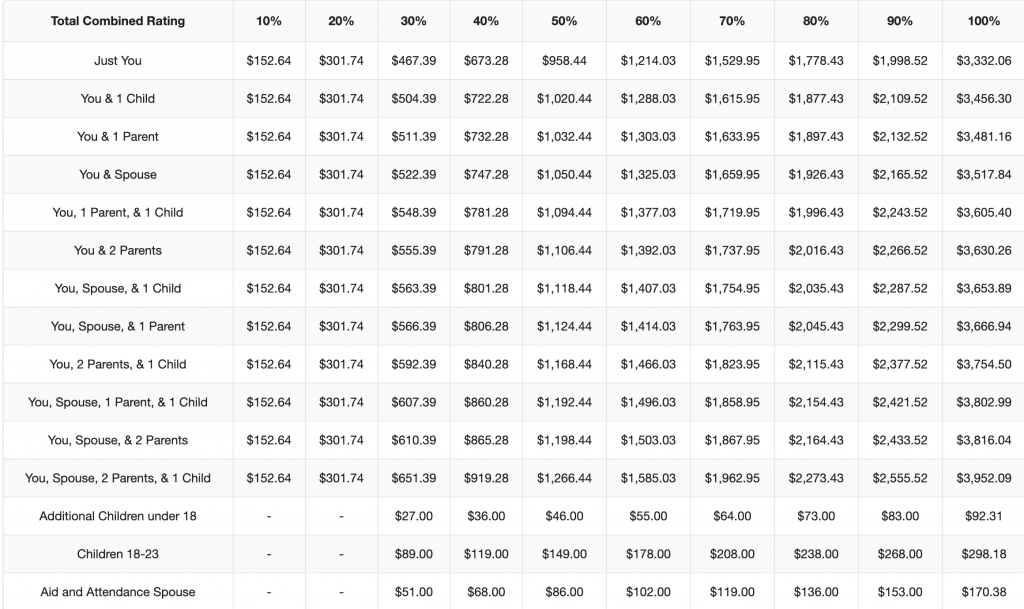
This payment is made on the first of every month for the rest of your life, tax-free. Rates rise each year with inflation. The rates shown above are current as of 2022 (they were expected to rise about 8.9% in 2023). Additional benefits may be available if you have a spouse or a child.
Once you earn a VA rating of at least 10%, you can apply for Chapter 31 benefits, also known as the Veteran Readiness and Employment program (VR&E). VR&E helps veterans with service-connected disabilities and an employment handicap prepare for, find, and keep work. You essentially meet with a VA counselor and use your disability rating to make the case that, with your current qualifications and disabilities, you cannot get an entry-level job in your chosen field — and that a degree in a particular field would help you find meaningful employment that your disability would not affect. The counselor then determines whether you are eligible. For example, say both knees received a 20% rating and you stated during your evaluation that you “cannot stand or walk for extended periods without pain,” while noting that an information-technology job can be done seated. On top of your Post-9/11 GI Bill benefits, if you are accepted into Chapter 31 you may receive a laptop, and your monthly stipend is based on the zip code of the school you attend. During the years you use this funding for your bachelor’s degree, you will not have to touch your GI Bill.
A master’s degree can yield the same outcome. If your application for a master’s is denied, you can use your GI Bill instead — and you will still have two years of it left after you finish.
There is no guarantee that VR&E will improve your learning outcomes; it is designed to help you gain the skills to land an entry-level job that your disability will not negatively affect. Still, you can use VR&E to fund your education. You only have to demonstrate how your disability prevents you from getting employment.
You only get one GI Bill
Remember that once you have used your Post-9/11 GI Bill, it is gone. If you served previously and later rejoined, your service record will not change and you will not be eligible for a second GI Bill.
If your pride is getting in the way and you feel you do not deserve or want to claim VA benefits — you do deserve them. Log on to eBenefits and apply for a Certificate of Eligibility (COE). If you cannot recall your eBenefits login, use the “forgot username” feature: you will get your username after providing your Social Security number and answering questions you already know. Repeat to reset your password, then sign in. Submit the COE application as soon as possible. The next step is to find a school you are interested in. Check whether it has a veteran services office — the vast majority do, and they can help you with everything I have described. My personal opinion is that I would not recommend a school that does not offer this, but that is just my opinion. They provide many services, including free counseling and free tutoring. As a bonus, a portion of your MCIs can be converted into credits — not a lot, but it helps. You will need to give the school your MOL transcript for the completed MCIs so they can convert the finished hours into credit hours.